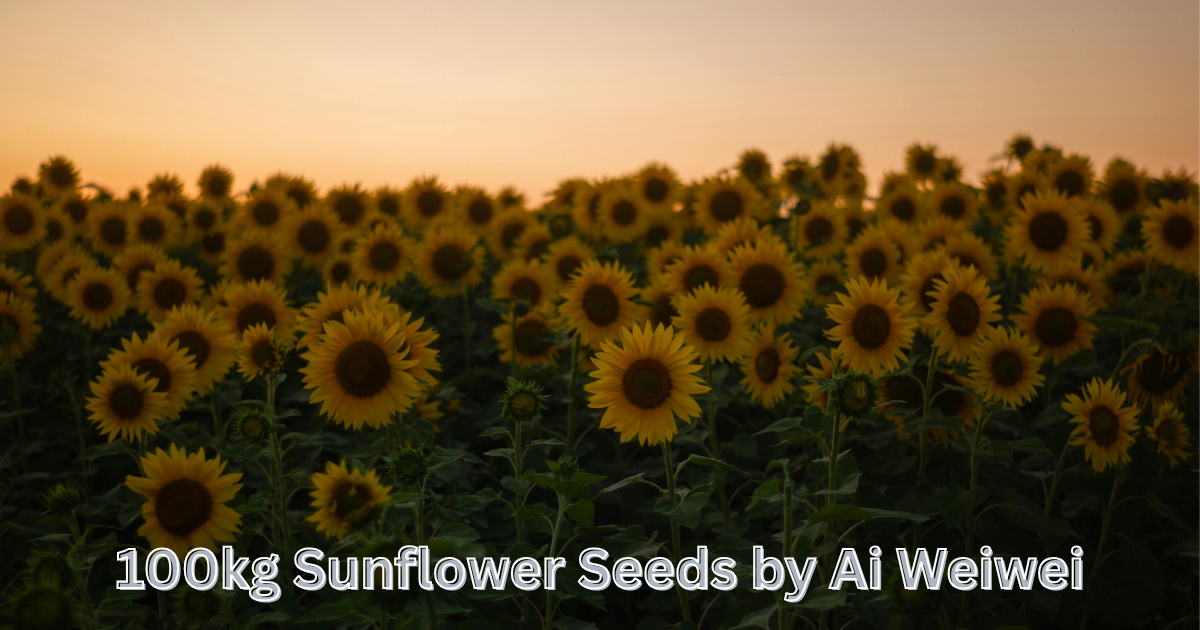
In the world of contemporary art, few works have made as much impact as Ai Weiwei’s 100kg Sunflower Seeds. This installation is not only a powerful statement on mass production and individuality, but also a deeply symbolic work reflecting Chinese society, history, and global art trends.
What is 100kg of Sunflower Seeds by Ai Weiwei?
100kg Sunflower Seeds is a large-scale contemporary art installation by Ai Weiwei, a renowned Chinese artist and activist. The work consists of millions of individually handcrafted porcelain sunflower seeds, painstakingly made by skilled artisans in Jingdezhen, China.
Despite its literal weight being symbolic, the installation represents:
- Mass production vs. individuality
- Chinese cultural history
- Consumerism and labor in modern society
- Collective identity in society
Ai Weiwei created the work in 2010, and it was famously exhibited at Tate Modern’s Turbine Hall in London, captivating audiences worldwide with its scale, craftsmanship, and meaning.
How it Works
Though the installation may seem straightforward, it involves a highly complex process:
1. Material Selection
- High quality porcelain clay was chosen for durability and realism.
- Each seed was meticulously shaped by hand to resemble natural sunflower seeds.
2. Craftsmanship
- Local artisans in Jingdezhen, a city known as the “Porcelain Capital,” crafted each seed.
- The work required thousands of man-hours, emphasizing the intersection of art and labor.
3. Painting and Firing
- Seeds were individually painted in black and white using traditional glazes.
- Each batch underwent firing in high-temperature kilns, ensuring consistency.
4. Installation
- The seeds were arranged to cover an entire hall floor, creating a visual sea of sunflower seeds.
- Visitors could walk on or observe the work, experiencing the overwhelming scale and texture.
5. Symbolism
- Sunflower seeds historically represented Mao Zedong, as propaganda images often depicted him as the sun and citizens as sunflower seeds.
- The work reflects both homage and critique, blending history with contemporary commentary.
Benefits and Significance
While art isn’t measured in practical benefits, Ai Weiwei’s 100kg Sunflower Seeds delivers multiple artistic and cultural impacts:
1. Raises Awareness
The work highlights the labor-intensive processes behind mass production and handcrafting.
2. Cultural Preservation
Supports traditional craftsmanship in Jingdezhen, keeping porcelain artistry alive.
3. Social Commentary
Invites reflection on Chinese society, individualism, and collective identity.
4. Educational Value
Exposes audiences to art history, contemporary installation techniques, and political discourse.
5. Global Recognition
Elevates Ai Weiwei as a leading contemporary artist while influencing international art movements.
Step by Step Guide: How the Work Was Created
- Concept Development – Ai Weiwei developed the idea of a massive field of sunflower seeds reflecting mass production and individuality.
- Artisan Collaboration – Local artisans in Jingdezhen were contracted to craft each seed.
- Material Preparation – Porcelain clay was refined and divided for individual seeds.
- Handcrafting – Each seed was molded and shaped by hand to mimic natural sunflower seeds.
- Painting – Seeds were painted black and white, applying traditional techniques.
- Firing – High-temperature kilns hardened the porcelain seeds.
- Quality Control – Every seed was inspected for uniformity and craftsmanship.
- Transportation – Millions of seeds were transported to the exhibition hall.
- Installation – Seeds were spread over the hall floor, covering thousands of square meters.
- Audience Interaction – Visitors could view, walk on, or study the seeds in detail.
Charts, Tables, and Unique Data
Table: 100kg Sunflower Seeds Project Scale
| Aspect | Quantity/Detail |
| Total Seeds Created | Approximately 100 million |
| Weight of Installation | ~100 kg |
| Time to Complete | Over 2 years |
| Artisans Involved | 1,600+ |
| Exhibition Space Coverage | Thousands of square meters |
| Firing Kiln Temperature | 1,200°C – 1,300°C |
Comparison Chart: Handcrafted vs. Mass-Produced Seeds
Artisanal Porcelain ██████████████████
Uniqueness ██████████████████
Time Investment ██████████████████
Mass-Produced Plastic ███
Uniqueness ██
Time Investment █
Interpretation:
Handcrafted seeds maximize artistic value, uniqueness, and labor investment, whereas mass-produced versions are faster but lack craftsmanship and cultural significance
Scenario Example
Exhibition at Tate Modern Turbine Hall
- Objective: Showcase the intersection of art, culture, and labor on a grand scale.
- Challenge: Logistical and installation complexities with millions of seeds.
- Solution: Detailed project management and artisan collaboration.
- Result: The installation became one of the most iconic exhibits in the Turbine Hall, receiving international acclaim and drawing hundreds of thousands of visitors.
This example demonstrates the combination of artistic vision, technical precision, and social commentary in Ai Weiwei’s work.
Common Mistakes and Misunderstandings
- Assuming All Seeds Are Natural – They are handcrafted porcelain, not edible.
- Misinterpreting Scale – While called “100kg,” the visual impact suggests millions of seeds.
- Ignoring Cultural Context – Sunflower seeds carry political symbolism in China.
- Neglecting Artisan Contribution – Thousands of skilled craftsmen contributed to the work.
- Underestimating Installation Complexity – Transporting and arranging millions of seeds requires meticulous planning.
Expert Tips for Understanding and Appreciating the Work
- Study Chinese History – Learn about Mao-era propaganda and symbolism of sunflowers.
- Observe Craftsmanship – Appreciate the detail and uniformity of each porcelain seed.
- Reflect on Scale – Consider the tension between individuality and collectivity.
- Understand Labor Dynamics – Recognize the effort and skill of artisans.
- Explore Contemporary Art Context – Compare with other large-scale installations worldwide.
FAQs
1. What are Ai Weiwei’s 100kg Sunflower Seeds made of?
They are made from hand-painted porcelain, not natural sunflower seeds.
2. Why did Ai Weiwei choose sunflower seeds?
Sunflower seeds symbolize Mao-era propaganda and collective identity, adding layers of political and social commentary.
3. How many seeds were created?
Approximately 100 million individual seeds were handcrafted.
4. Can you walk on the seeds?
During some exhibitions, visitors could walk on the seeds, though protective measures were taken.
5. Where were the seeds made?
They were crafted in Jingdezhen, China, known for its porcelain production.
6. What is the main message of the installation?
The work reflects mass production, individuality, Chinese history, and social commentary on labor and society.
7. How long did it take to complete the project?
The project took over two years to complete, involving over 1,600 artisans.
Conclusion
Ai Weiwei’s 100kg Sunflower Seeds is more than a contemporary art installation; it is a cultural, political, and social commentary. Through millions of meticulously handcrafted porcelain seeds, the work explores themes of individuality, mass production, labor, and Chinese history.
From the technical craftsmanship to the symbolic depth, the installation demonstrates how art can convey powerful messages while honoring traditional skills. It remains an iconic work of modern art, influencing artists, historians, and audiences worldwide.
By understanding the creation, symbolism, and impact of this work, viewers can fully appreciate Ai Weiwei’s genius and the immense effort behind this monumental installation.